Kluup opens on the question you came with, puts the headline figure first and keeps the
evidence one click away. Every picture below is the real product, photographed from a
running Kluup.
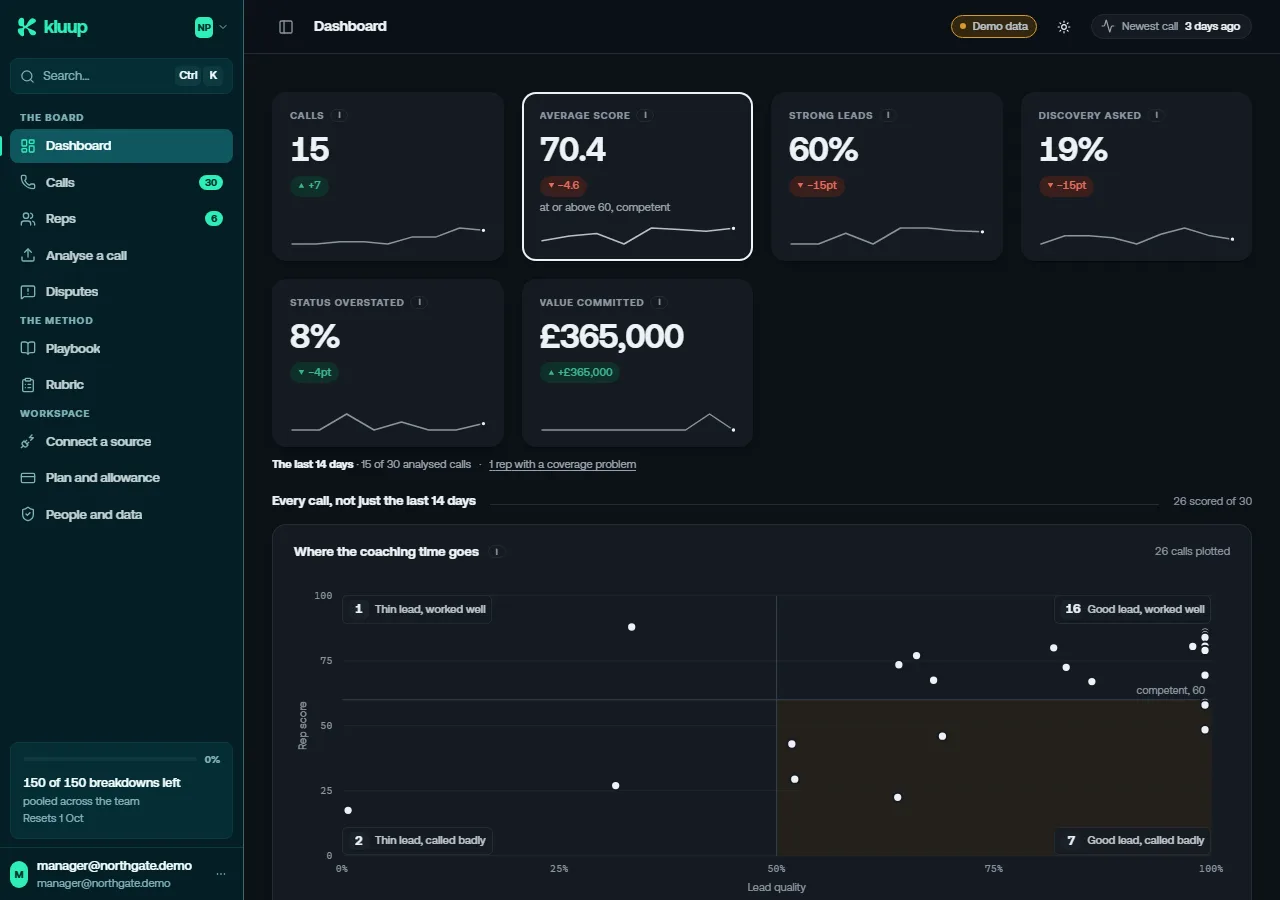
The dashboard. Six figures, each with what it was last fortnight underneath, and a
plot that puts rep score against lead quality so you can see which low scores were hard
calls. The rail's foot carries the allowance meter, because a manager should never wonder
what is left. Northgate Property Partners is a fictional floor and every figure in it is
generated — which is what the product's own “Demo data” marker says on the screen.
The lead and the rep are two different questions.
The gate verdict
describes the lead
Was there a real, workable buyer on the end of this call at all?
Essential: right person · reason and engagement · genuine buying intent · a next step the lead owns
Quality: budget or means · direction identified
Verdict: Strong lead · Workable lead · Not a live lead
The score
describes the rep
Given whoever that turned out to be, what did the rep do with it?
A weighted average of your scorecard's dimensions, rescaled to 0–100
Bands calibrated so 60 means competent, not good
Every dimension scored from a quote you can read
Each gate carries the words it was decided on.
A next step is only a next step if the lead owns it — a booked visit, a reservation, a
deposit, a second call on a day they named. “I'll send it over and ring you next week”
does not pass.
A competent but unremarkable call is five or six out of ten on a dimension, and the
product says so. Scores are only comparable within a call type
and a channel, and the league table keeps them apart.
The scorecard comes from your calls — not from a template with your logo on it
You answer three questionsWhat you sell, who you call, and what a good outcome looks like.
Kluup reads a sample of your real callsConnected, uploaded, or the demo workspace if you want to look around before committing anything.
It shows you what it derived, in your wordsEach dimension, each gate and each playbook item comes with the call that justified it, so you can see where it got the idea.
You edit itRename, reweight, remove. Nothing is scored against a rubric you have not agreed to.
Change your mind later and history followsRecords store the raw judgements, so changing a weight re-scores everything already in the system rather than leaving old calls on the old rules.
2 call types are included, because almost every floor runs
more than one motion — outbound plus demos, or outbound plus inbound. Each gets its own
dimensions, its own gates and its own playbook, and calls are only ever compared within
the same one.
Changing a dimension is not free, and the product says so before you do it.
Adding or redefining a dimension means re-running old calls from the audio Kluup still
holds. The editor shows what that will cost and what it will re-score — and says plainly
which calls fall outside the 90-day audio window and therefore
cannot be re-scored at all, rather than inventing a number for them.
Building a scorecard from a new set of calls is the one step here we have not yet run
all the way through on our own. It is built, and the screen you would review it on is
built; see the note at the foot of this page.
The breakdown, move by move.
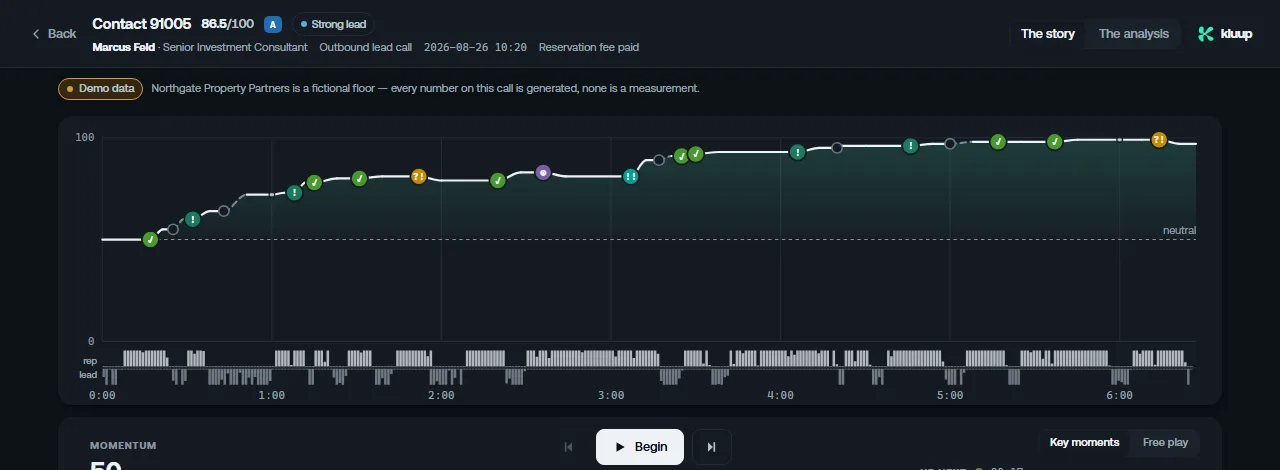
Kluup · the full analysis of one call — demo workspace, every figure generated
The line is momentum — how likely this call was to end in a sale at that instant, not
how friendly the lead sounded. The view opens on the biggest single drop, the moment the
call actually turned, rather than at the beginning. A lead-driven change is a dashed step
and a rep-driven one is solid, so a fall the lead caused is never read as a fall the rep
caused. Demo workspace; every figure generated.
The model chooses which words mattered. The machine decides when they were said.
The analyst cannot write a timestamp. Kluup finds the quoted words in the recording's own
word-level timing and reads the clock off the audio. Where a call reaches Kluup with no
recording — the demo workspace above is one — the times come from the transcript's own
turns instead, and every figure that rests on that clock carries ≈ and the words
estimated from the transcript, not measured.
Kluup · how your score was reached — demo workspace, every figure generated
Demo workspace; every figure generated.
!!Brilliant
!Great
✓Good
?!Inaccuracy
?Mistake
??Blunder
⊙Missed chance
●Lead move
The default vocabulary. It lives in your scorecard, so the labels and their colours are
yours to change.
The breakdown is a separate operation from the score, deliberately. Scoring is
included in the seat; the breakdown is the expensive half, so it is its own decision and
its own meter. Score every call; break down the ones worth an hour.
The league table shows its working — calls analysed against calls attempted, always
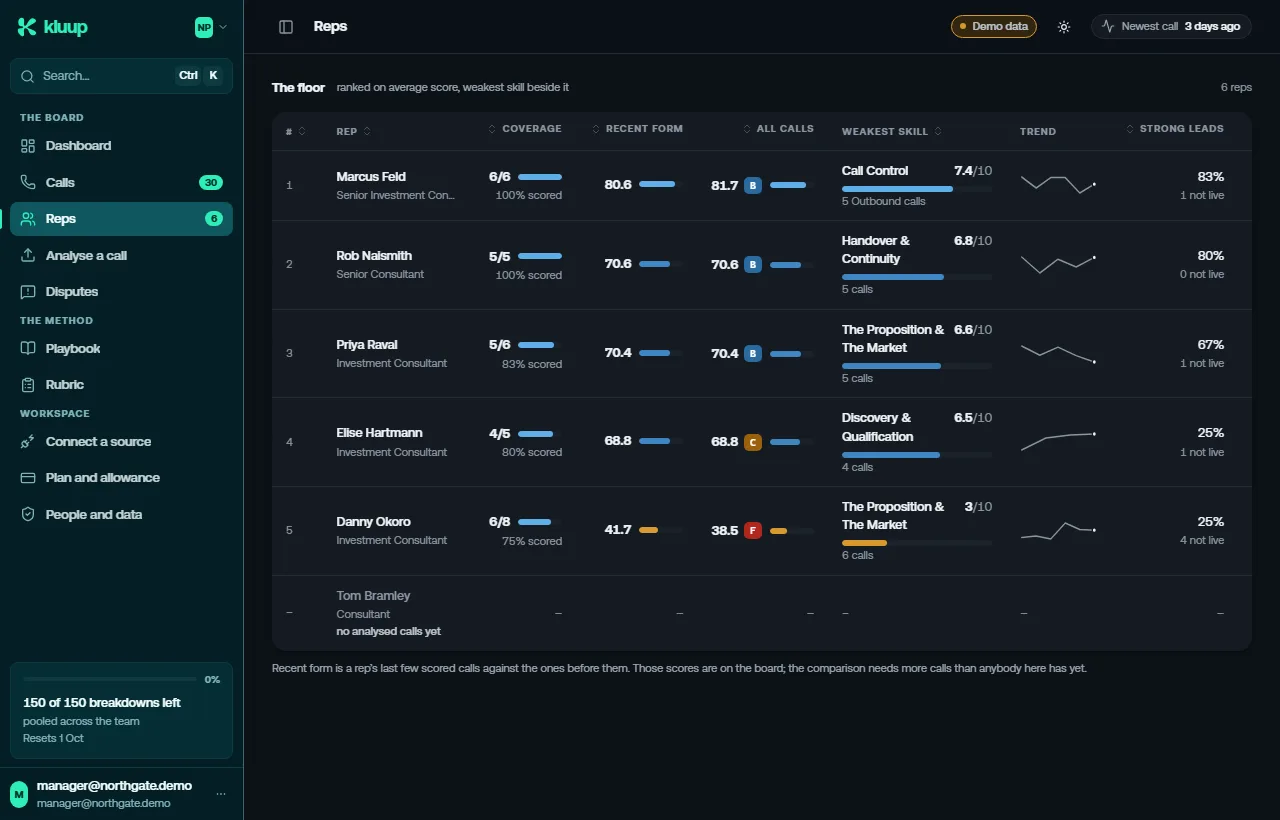
Kluup · the floor, ranked — demo workspace
Coverage sits beside every average, because three scored calls are not thirty. A rep
with nothing analysed gets dashes and no rank, not a flattering blank. Demo
workspace; every figure generated.
A ranking that ignores coverage is measuring the sample, not the rep.
Scores are only comparable within a channel. A rep working warm inbound will out-convert
a rep working a cold list on lead quality alone, and a table that ignores that measures
the funnel. Kluup keeps them apart and says so on the screen.
Short dials still count as calls attempted. Anything too short to contain a conversation
never reaches a model and never consumes an allowance, but it is not quietly dropped
from the count either. A rep with two prior calls gets “no baseline yet” instead of a
change worked out from one call.
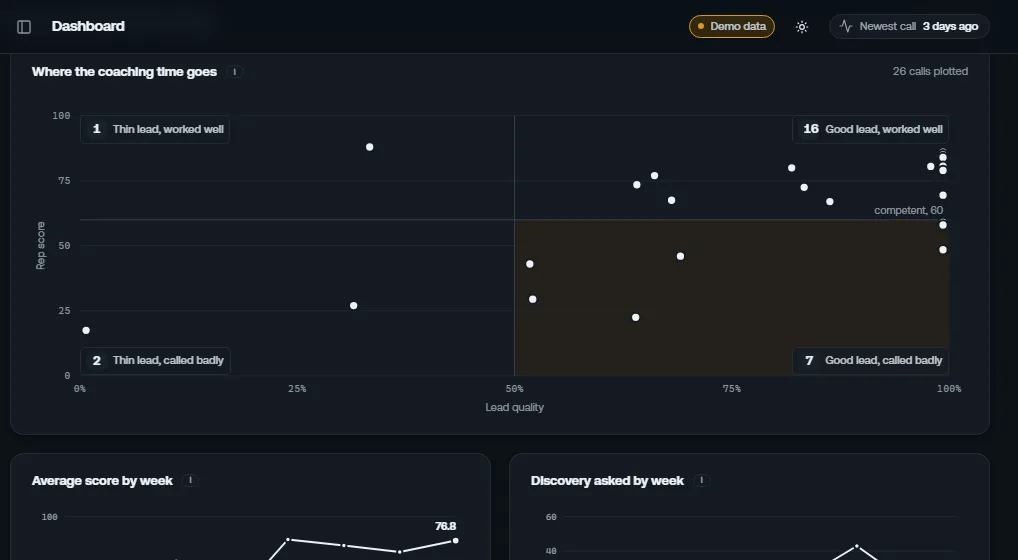
Kluup · where the coaching hour goes — demo workspace
Four counted outcomes, so an hour of coaching goes where it changes something.
Your reps see the same thing you do.
A rep can see everything about themselves, and nothing about anyone else.
A rep sees their own calls, their own scores and the quotes behind them. They do not see
another rep's quotes, another rep's scores, or the league table. That is enforced by the
database, not by hiding a menu item.
Disputes travel with the record. A rep can contest a score; the disagreement stays
attached to the call, so anyone who reads that score later sees it. Only a manager can
mark a dispute resolved, and removing it entirely means deleting the call. The rep view
and the dispute route are included for every customer, cannot be switched off, and are not
a paid tier — they are what makes a scored rep lawful to manage.
Kluup · a rep reading their own call — demo workspace
A strong lead and a poor call, on the same screen, kept apart, with the dispute route on
the page and not buried in a help centre. Demo workspace; every figure generated.
Getting your calls in
connector, upload, or look around the demo first
Connect a source
Before anything is authorised, the connect screen shows the exact scopes asked for, what
Kluup reads, what it never reads, and what happens next. It samples one recording to
check whether your calls are dual-channel and tells you what you will get before you
finish setting up.
Upload recordings
Drop files in. Kluup probes each one, gates out anything too short to contain a
conversation, splits the channels and transcribes them. Works with whatever your phone
system exports.
Open the demo workspace
A ready-made, clearly-labelled fictional floor with scored calls, a league table and full
breakdowns, so you can judge the product before you hand it a single real recording. It
is a step inside the trial rather than a public sandbox — you sign up first, and no card
is asked for.
Transcription is ours, and per channel
Kluup never ingests a CRM's transcript. It takes the audio and transcribes each channel on
its own hardware, because a stereo recording puts the rep in one ear and the lead in the
other — which makes “who said this” a recorded fact rather than a guess. The transcript is
held in memory for the length of one analysis and is never written to disk.
If your recordings are single-track, Kluup will not guess. You still get activity, the lead
gates, the verdict and the score; you do not get the breakdown, attributed quotes, talk
ratio or the timeline. The full policy is on the pricing page,
on the page before you sign up.
The same rule runs inside a call. A share of the talking Kluup could not attribute to a
speaker is left blank and says why — never printed as 0%, which would read as a rep
who said nothing.
Deliberately not built
so you can rule Kluup out quickly if it is wrong for you
Live call assistance. Kluup reads a call after it happened. No whisper prompts, no cue cards.
Forecasting or pipeline management. Your CRM owns the pipeline.
A dialler. Keep the phone system you have.
Cross-customer benchmarking. No data crosses a tenant boundary for any purpose, so there is no industry average to sell you.
A mobile app. A laptop tool for a manager with four minutes.
Emotion or tone scoring. Never, in any jurisdiction. Prohibited in the workplace by Article 5(1)(f) of the EU AI Act, and a bad idea besides.
Two steps we have not finished testing
We would rather you read this here than find it out in week two. Two things are built but
have not yet been run end to end by us: scoring a call you have just uploaded, and
building a scorecard from a new set of calls. Getting the recording in, checking its
length and transcribing it are done and timed. If the scoring step cannot run, the call
stops there and tells you; nothing is filled in for it.
Everything else on this page — the scores, the breakdowns, the timeline, the league table,
the rep view, the dispute route and the allowance meter — is drawn from calls that really
went through it.
Look at your own calls in it.
14 days, 10 full breakdowns, no card. Or take the demo-workspace
step inside the trial and judge it on someone else's floor first.