
Score every call.
Judge every lead.
Never confuse the two.
The scorecard is built from your own calls.
- What it is
- Call scoring, with the evidence Every call scored 0–100 against your scorecard, with the quote behind each number and what should have been said instead.
- Who it is for
- Managers with a floor to rank From 3 reps up. A seat is a rep whose calls are scored — everyone who only reads the results logs in free.
- What it costs
- £59 per seat, per month Billed annually; £75 month to month. 3 seats minimum, so £177 a month. 14 days free, 10 full breakdowns, no card.
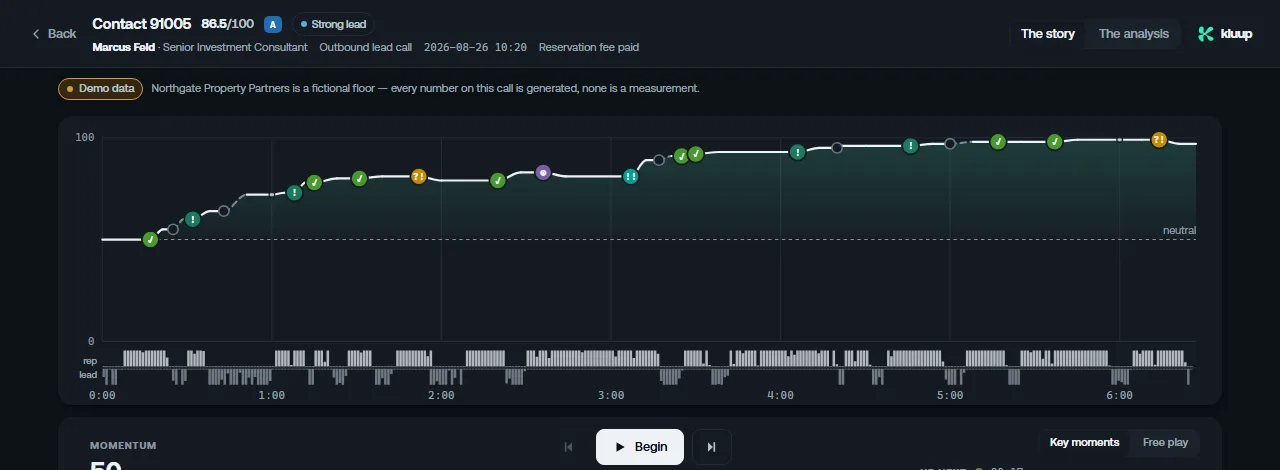
Two numbers, and they are meant to disagree.
The gate verdict describes the lead. The score describes the rep.
Most leads out of a content funnel are poor. “Not a live lead” is usually a verdict on the funnel, not on the rep who rang it.
A rep who tests a dud properly, works out fast that there is no buyer, closes it and leaves an honest CRM status has done an excellent job. They will score in the seventies or eighties beside a “Not a live lead” verdict. Rolling those two into one number is the mistake Kluup exists to stop.

Every score cites the words that earned it.
How the breakdown reads →Every dimension opens onto the sentence that produced it.
What it was worth, what it scored, the finding in one line, and the words the rep actually said. A score with no quote behind it is shown as unjudged instead of as a number, and it stays out of the average.

- !!Brilliant
- !Great
- ✓Good
- ?!Inaccuracy
- ?Mistake
- ??Blunder
- ⊙Missed chance
The move vocabulary on the timeline above. It lives in your scorecard, so the labels and their colours are yours.
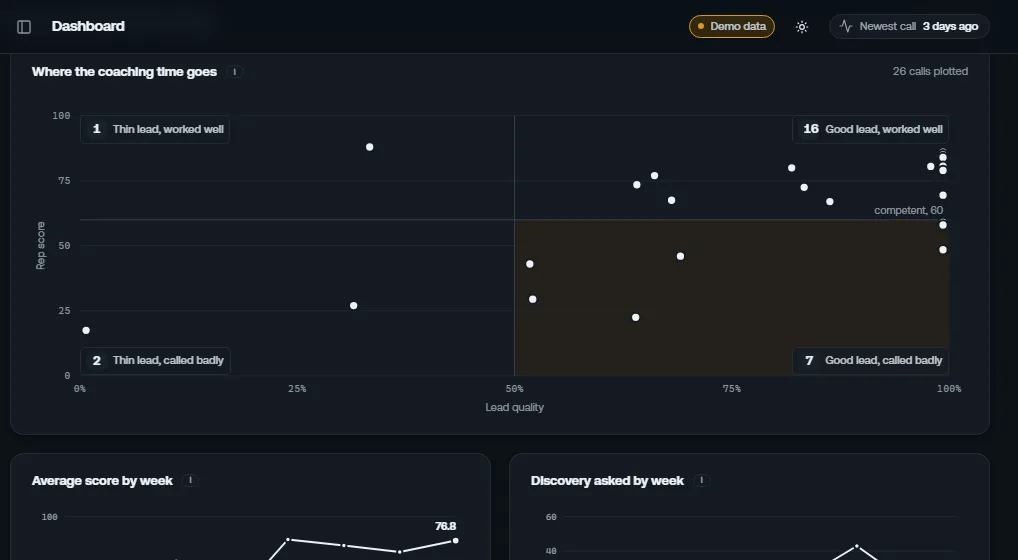
The league table shows its working.
How ranking works →Calls analysed sits beside calls attempted, on every row.
Three scored calls are not thirty, and the table says which it is showing you. A rep with nothing analysed gets dashes and no rank instead of a flattering blank, and reps working different channels are marked as not doing the same job.
The plot underneath splits the floor four ways: good lead worked well, good lead called badly, thin lead worked well, thin lead called badly. An hour of coaching goes where it changes something.
How a call becomes a record
the whole path, in the order it happens
- The recording arrivesConnect your phone system or CRM, or upload files. Dual-channel recordings are worth asking for and Kluup checks yours before you finish setting up.
- Kluup transcribes itOn our own hardware, each channel separately, so who spoke is a recorded fact. We never take a CRM's transcript, and the transcript is never written to disk.
- Short dials are gated outAnything too short to contain a conversation never reaches a model and never costs you an allowance — but it still counts as a call attempted.
- The call is scoredAgainst your scorecard, with the lead gates judged separately. Scoring is included in the seat.
- The breakdown is a separate, deliberate actThe move-by-move read costs real money to produce, so it is its own decision and its own meter — 25 a seat a month, pooled across the team.
The scorecard is built from your calls, not from ours. Kluup reads a sample of your real conversations and derives the dimensions, the gates and the playbook it will judge against, shows you what it derived in your own words with the call that justified each item, and lets you edit it before anything is scored.
Nobody types a timestamp. The model chooses which words mattered; the machine finds those words in the recording and reads the clock off the audio. Where a call reaches Kluup with no recording — the demo workspace is one — the times come from the transcript's own turns, and every figure that rests on them carries ≈ and the words estimated from the transcript, not measured.
Change a weight and history re-scores. Records store the raw judgements, so every derived number is computed fresh. Nothing in your history is frozen at the moment it happened to be scored.
What it costs — published in full, because every competitor makes you ask
The full price sheet →What Kluup does not do
the list, so you can rule Kluup out in a minute
- Live call assistance. No whisper prompts, no real-time cue cards. Kluup reads a call after it happened.
- Forecasting or pipeline management. Your CRM owns the pipeline; Kluup does not try to.
- A dialler. Keep the phone system you have.
- Cross-customer benchmarking. No data crosses a tenant boundary for any purpose, including our own improvement — so there is no industry average to sell you.
- A mobile app. This is a laptop tool for a manager with four minutes between calls.
And one thing we will never do. How a voice sounds is never scored — not its tone, not its pitch, not how loud it was — and Kluup does not infer a rep's emotions from it: not stress, not frustration, not enthusiasm, not confidence. Inferring emotion in the workplace is prohibited by Article 5(1)(f) of the EU AI Act and has been since February 2025, and it would be a bad idea regardless.
Kluup judges the content of what was said against your scorecard, and counts facts about turn-taking from the words and the turns — never from how a voice sounded. How your data is handled →
Fourteen days, ten full breakdowns, no card.
Sign up, answer three questions about what you sell and who you call, then connect a source, upload a handful of recordings. Or open the demo workspace, a step inside the trial, and look around before you hand Kluup a single real recording.